











)
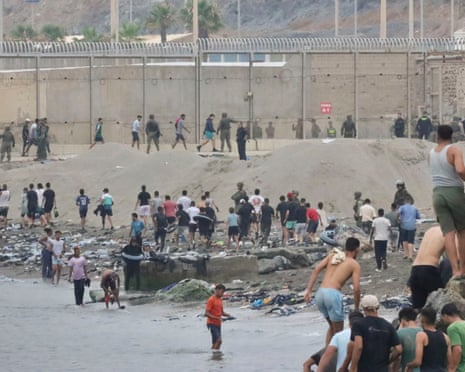
Good morning. Last week, an estimated 72,000 migrants began crossing into a tiny Spanish enclave on the tip of Morocco. Within 24 hours, most of them had headed home. At least 88 people died after attempting the crossing, according to local officials. This isn’t the whole story of what happened over the last week, but the facts are worth remembering.
At an emergency meeting yesterday, EU interior ministers sought to draw a line under Ceuta, insisting that the passport-free Schengen area had never been at risk from the arrival of migrants at this scale. Despite this, much of the media coverage has suggested that events in Ceuta represent a territorial threat to Europe, sparking calls for greater security across the region’s borders.
It’s a pattern that has become familiar since the 2015 refugee crisis. As Europe has created fewer opportunities for migrants to legally cross its borders, people have tried to cross them illegally, resulting in dangerous bottlenecks, human tragedies, and a slew of spectacular images that the right has seized upon to justify draconian policies.
For this morning’s newsletter, I spoke to Daniel Trilling, a journalist who writes about refugees and migration, about the political actors trying to capitalise on Ceuta, and why tragedies like this are bound to keep happening. That’s after the headlines.
Five big stories
Environment | Eight of the biggest oil companies amassed profits of more than $90bn (£67bn) in just three months as the Iran conflict sent energy prices soaring and the emissions-fuelled climate crisis caused deadly heatwaves.
UK politics | Women should not feel pressurised into experiencing an “ideal birth”, the new health secretary, Yvette Cooper, has said, promising a root-and-branch reform of standards after several damning maternity scandals.
Middle East | Jordan is convening an emergency meeting over an “imminent” threat of an Israeli takeover of the most important Muslim site in Jerusalem, with the potential to “trigger a religious conflict”.
Ukraine | Russian strikes in and around Kyiv killed at least 14 people, injured 27 and damaged warehouses, emergency service officials said. Some reports put the death toll at 15.
Ceuta | Hundreds of people have gathered in the northern Moroccan town of Fnideq, near the border with Spain’s Ceuta, flashing photos of their missing loved ones to passersby in the hope of tracking them down.
In depth: ‘The claim that this is some kind of invasion of Europe is entirely untrue’
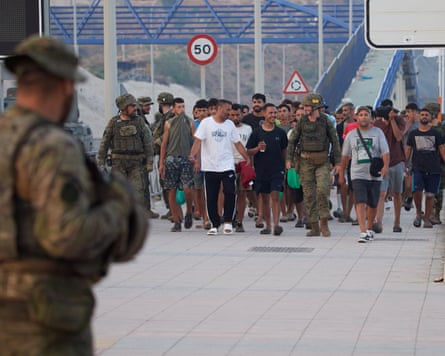
Migrants who crossed into Spain via Ceuta are escorted by the Spanish army back to Morocco. Photograph: Antonio Sempere/AP
On Thursday, a group of people roughly the size of Guildford’s population began crossing into Ceuta. Many of them swam around the border fence. Some drowned; others were crushed. Dozens died. “There were so many people in the sea. Everyone was trying to grab on to you to save themselves, and you were trying to escape and move forward so they wouldn’t drag you down or drown you,” one told the Guardian.
Most of these people were young men searching for work and hoping to build a better life for themselves. There are no reports suggesting any of them reached mainland Europe. “It’s very difficult for people without the right documents to travel from Ceuta to mainland Europe, and Spain has lots of experience returning people who cross without permission,” Trilling says. “So the claim that this is some kind of invasion of Europe is entirely untrue.”
Although Spain was reporting <a href="https://www.bbc.co.uk/news/articles/cx2kp…
📌 Fonte: The Guardian
📢 Fique ligado no História Animada para mais notícias!
Comments