










)
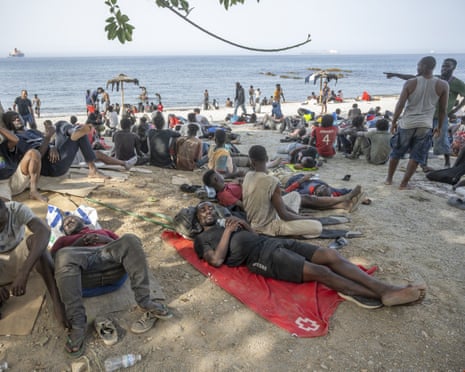
Four days ago, Youssef El Abbas saw an opportunity to reclaim the life he had lost seven years earlier. News was circulating that about 400 people had swum from Morocco to the neighbouring Spanish enclave of Ceuta on the north African coast, approximately 12 miles (19km) across the strait of Gibraltar from mainland Spain.
Here was a chance for the 44-year-old Moroccan father of four to return to Spain, from which he had been deported when his residency expired after the loss of his job in Bilbao in 2019.
El Abbas took a taxi and headed to the city of Tétouan, south of the enclave. While en route, he saw Facebook posts and news reports claiming that the Moroccan authorities were allowing people to pass through their side of the border. That meant that unlike those who had crossed the previous night, he could simply travel overland before swimming for just five minutes across the border from Moroccan to Spanish territory to avoid the Spanish border controls.
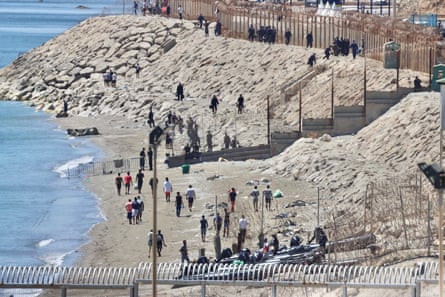
People returning to Morocco on Sunday after crossing into Ceuta. Photograph: Reduan Dris/EPA
He reached Tétouan to find the city completely overwhelmed. “Young men were running through the streets, flooding every corner,” he said. By the time a second taxi took El Abbas to Fnideq, the town bordering Ceuta, he realised that the usual blockades and checkpoints preventing people without European documents from even approaching the frontier had been removed.
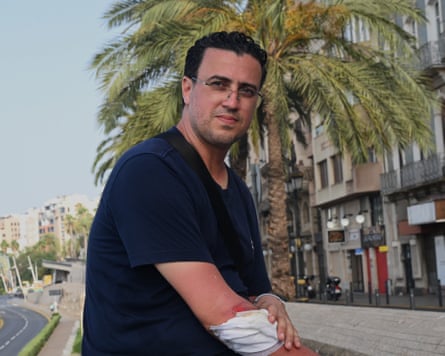
Youssef El Abbas in Ceuta. Photograph: Okba Mohammad
“The Moroccan police were shouting at us: ‘Go, go, go! Run now, run into Spain,’” he said. “The night before, they were beating people. But that morning they were letting us through. Nothing made sense.”
Despite the crowds, El Abbas noticed the police were only letting Moroccans cross over. “All the sub-Saharan migrants were being pushed back by force.”
He reached the border at 2.45pm on Wednesday. By 3pm, after a short swim, he was standing on Spanish soil. Not everyone was so lucky.
“In just 10 minutes in the water, I saw four people floating dead in Moroccan waters,” he said. “People were pulling their bodies out.” They were among at least 72 people who drowned or were crushed trying to reach the Spanish territory.
El Abbas is just one of the 50,000 or so people to have crossed into Ceuta this week, in what Spain’s prime minister, Pedro Sánchez, described as “a violation of Spain’s territorial integrity”.
Madrid has attributed the latest influx to “human-trafficking mafias” that have taken advantage of a decision by Spain’s supreme court, which recently ruled that those intercepted at sea while trying to enter Ceuta or Melilla – the other Spanish enclave on the north African coast – could not be summarily returned under special rules.
But there has also been speculation that the Moroccan authorities may have opened the border to signal their displeasure at Sánchez’s recent visit to Algeria, which supports efforts to free the disputed territory of Western Sahara from Moroccan occupation.
Morocco’s ambassador to Spain, Karima Benyaich Millán, said Rabat was not happy about the mass crossing, adding that it hoped those in Ceuta would return.
Moroccan government sources told the Europa Press news agency that the surge of people entering Ceuta was down to “criminal organisations” and insisted that Rabat’s cooperation with Spain remained “exemplary”.
In May 2021, Rabat loosened border controls – allowing 10,000 people to cross into Ceuta over the course of two days – during a diplomatic standoff trig…
📌 Fonte: The Guardian
📢 Fique ligado no História Animada para mais notícias!
Comments