










)
A growing chorus of voices have accused Morocco of helping to fuel the crisis in Ceuta, with the leader of the Spanish enclave describing last week’s border crossings as an attack on Spain’s territorial integrity that was seen as being “if not orchestrated, at least encouraged or permitted by Morocco”.
Spain’s interior ministry said late last week that 48,300 of the roughly 50,000 people who had turned up in Ceuta, a tiny Spanish territory in north Africa, had been sent back to Morocco. The extraordinary influx had overwhelmed the city of 84,000 and set off a political crisis across the EU as some member states laid blame on Spain.
In Ceuta, leaders pointed to the broader picture of what had transpired. “It’s an atrocity,” said Juan Jesús Vivas, the long-serving conservative leader of the territory. “There are 88 bodies in the morgue, and there are more on the other side of the border.”
He said local people watched the events play out with a mix of sadness, worry and anguish. “People see this not as a migration crisis; it was fundamentally an attack, a violation of Spain’s territorial integrity,” Vivas told El País newspaper. “People felt that this, if not orchestrated, was at least encouraged or permitted by Morocco.”
He drew a parallel with May 2021 when Rabat loosened border controls, allowing 10,000 people to cross into Ceuta over the course of two days, during a diplomatic standoff over Madrid’s decision to allow a Western Sahara independence leader to be treated for Covid-19 in Spain.
The insinuation of Moroccan involvement appeared to be backed by the preliminary assessment of Spanish intelligence services, who cited suspicions that the influx had not been planned by Moroccan authorities but concluded that Morocco had failed to stem the tide of people rushing towards the border and in some cases had even facilitated their passage.
Intelligence sources told El País that the roots of the influx probably lay in a hoax that had swiftly spread across social media after a Spanish supreme court ruling that migrants arriving by sea could not be summarily deported. As the hoax gained steam online, Moroccan border surveillance dwindled to a minimum until it was completely lifted late last week, allowing tens of thousands of people to stream through.
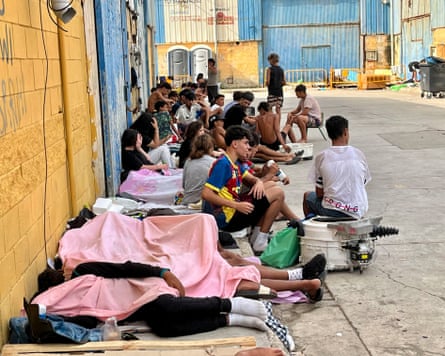
People who crossed from Morocco sit on a street in Ceuta on Monday. Photograph: Reduan/EPA
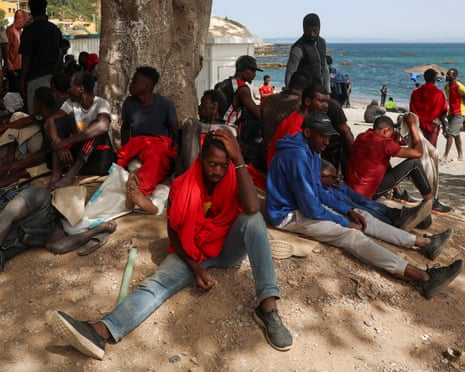
In Ceuta on Monday, hundreds of people continued to sleep rough on the beach or near Ceuta’s mosques.
Ashraf, 28, said he had defied his mother’s warnings against crossing into Spain after spotting posts on social media that said the border had been opened. While he had made it to Ceuta, what had followed was a days-long ordeal as he scrambled to find food and shelter while fending off the memories of what he had lived through.
“You might see me smile a little but inside I’m shattered,” the Moroccan national said as he recalled swimming past bodies to reach Ceuta. “There were so many people in the sea. Everyone was trying to grab on to you to save themselves, and you were trying to escape and move forward so they wouldn’t drag you down or drown you. The Moroccan police were pushing us toward the water and telling us ‘swim, swim’.”
Others were desperately seeking loved ones who were missing. One mother said she had been roaming the streets of Ceuta for days, frantically searching for any sign of her children aged 13 and 16.
The three had left Morocco together, plunging into the sea to make their way around the border. As strong currents pulled at them, she lost sight of her children.
“I need help,” she said as she held up a photo of a smiling young boy flashing a thumbs-up sign. “Some migrants told me they had seen them in Ceuta, but I can’t find them.”
Across the EU, the crisis in Ceuta had seemingly ushered in a moment of reckoning after a handful of EU countries responded to the crisis by calling for Spain to be suspended from the Schengen free-movement zone.
<p class…
📌 Fonte: The Guardian
📢 Fique ligado no História Animada para mais notícias!
Comments